A Unique Hands On Science Night
  • Home
    • Hands-On Science Night!
    • Preparing for Science Night >
      • Getting Started -1/06/12
      • Experiments Showcase - 1/13/12
      • How to Submit a Proposal - 1/20/12
      • Searching for Experiments - 1/27/12
      • Submitting Proposal - 2/6/12
      • Project Review - 2/10/12
      • Past Science Night Experiments >
        • Science Night 2014 >
          • Biology >
            • You Eat With Your Eyes First
          • Chemistry >
            • Rapid, Rainbow, Bounce
            • Homemade Hand Warmers
            • Enviro Power
            • Electric Gas
            • GLUEP
            • Blowing Up Balloons with CO2
            • Tusker Toothpaste
            • Balloon Experiments
            • Elephant Toothpaste
            • The Secret of Diapers
            • Super Absorbent Crystals
          • Physics >
            • Rainbow Milk
            • The Amazing Static Balloon
            • Bubbling Lamps of Lava
            • The Floating Egg
            • Marshmallow Cannon
            • Dry Ice Bubbles
            • Fog Tornado
            • Fun with Electromagnets
            • Poke that Polymer
            • The Square Bubble
            • Lava Lamps
            • How to Make an Egg Float
            • Super Can Crusher
            • How to Make a Homemade Lava Lamp
            • Monster Bubble
            • Levitating Orb
            • Magical Egg Bottle
            • Power of the Metal
            • Dry Ice Bubbles
            • Lava Lamps
            • The Screaming Balloon
            • Dancing Craisins
            • Colorful Densities
            • Color Separation
            • Center of Gravity
        • Science Night 2013 >
          • Biology >
            • Sensory Analysis
            • Sweet Polymers
          • Chemistry >
            • Awesome Bubbles
            • Balloon Expansion
            • Breaking Up Molecules
            • Bubble Up
            • Cabbage Chemistry
            • Color Explosion
            • Colored Bubbles
            • Fizz Inflator
            • Fool's Gold
            • Glowing Water
            • Gooey Gluey Slime
            • Holly and Jennie's Lava Lamp
            • Light Up
            • Making Bubbles
          • Earth Sciences >
            • Colorful Convection Currents
            • Ice Ice Baby
          • Physics >
            • Boo Bubbles
            • Bouncing Sounds
            • Can Crushers
            • Candle Vacuum
            • Candy Fizz
            • Colors of Light
            • Floating Paper Clip
            • Levitating Orb
            • Magical Bottle
            • Rainbow Density
            • Ready, Set, ... Throw!
            • Sink or Float?
            • Surface Tension
          • Technology >
            • Air Vortex Cannons
            • Chip Ship Challenge
            • Lemon Power
            • Wing Or No Wing?
        • Science Night 2012 >
          • Projects >
            • Chemistry >
              • Electrolyte Challenge
              • Homemade Hand Warmer
              • Elephant Toothpaste I
              • Tusker Toothpaste
              • Elephant Toothpaste III
              • Tasty Frozen Science
              • Purple Cabbage and Bases and Acids
              • Rainbow Milk
              • Pop Rocks and Soda
            • Science Night 2015 >
              • Chemistry >
                • Team 1
                • Team 3
                • Team 5
                • Team 6
                • Team 10
                • Team 11
                • Team 12
                • Team 13
                • Team 14
                • Team 19
                • Team 23
                • Team 30
                • Team 31
                • Team 32
                • Team 34
                • Team 35
                • Team 36
                • Team 37
                • Physics >
                  • Team 4
                  • Team 7
                  • Team 8
                  • Team 9
                  • Team 15
                  • Team 16
                  • Team 17
                  • Team 18
                  • Team 20
                  • Team 24
                  • Team 29
                  • Team 33
                  • Team 38
                  • Team 44
                • Team 39
                • Team 41
                • Team 42
                • Team 43
                • Team 45
                • Team 48
              • Technology >
                • Team 21
                • Team 26
                • Team 40
                • Team 47
              • Biology >
                • Team 2
                • Team 22
                • Team 28
                • Team 27
                • Team 46
            • Engineering and Technology >
              • World's Simplest Motor
              • Magnetic Levitation Train
            • Physics >
              • Water Filter
              • Stacking Liquids
              • Egg in a Bottle
            • Biology >
              • Infected!
      • A Helpful Presentation Board - 2/10/12
      • Hands-On all the way - 2/17/12
      • Practice, Practice , Practice - 3/02/12
      • More Practice 3/2/12
      • Rehearsal Afternoon - 3/15/12
    • passports
    • teaminfo
  • Run your own Science Night
  • Who are we?
  • Science Night 2016
    • Chemistry >
      • Team 2
      • Team 4
      • Team 5
      • Team 7
      • Team 13
      • Team 14
      • Team 15
      • Team 16
      • Team 18
      • Team 20
      • Team 21
      • Team 27
      • Team 28
      • Team 31
      • Team 32
      • Team 33
      • Team 34
      • Team 35
      • Team 36
      • Team 40
    • Physics >
      • Team 1
      • Team 3
      • Team 6
      • Team 9
      • Team 11
      • Team 17
      • Team 19
      • Team 22
      • Team 23
      • Team 24
      • Team 25
      • Team 26
      • Team 29
      • Team 30
      • Team 37
      • Team 38
      • Team 42
      • Team 43
      • Team 44
    • Technology >
      • Team 12
      • Team 39

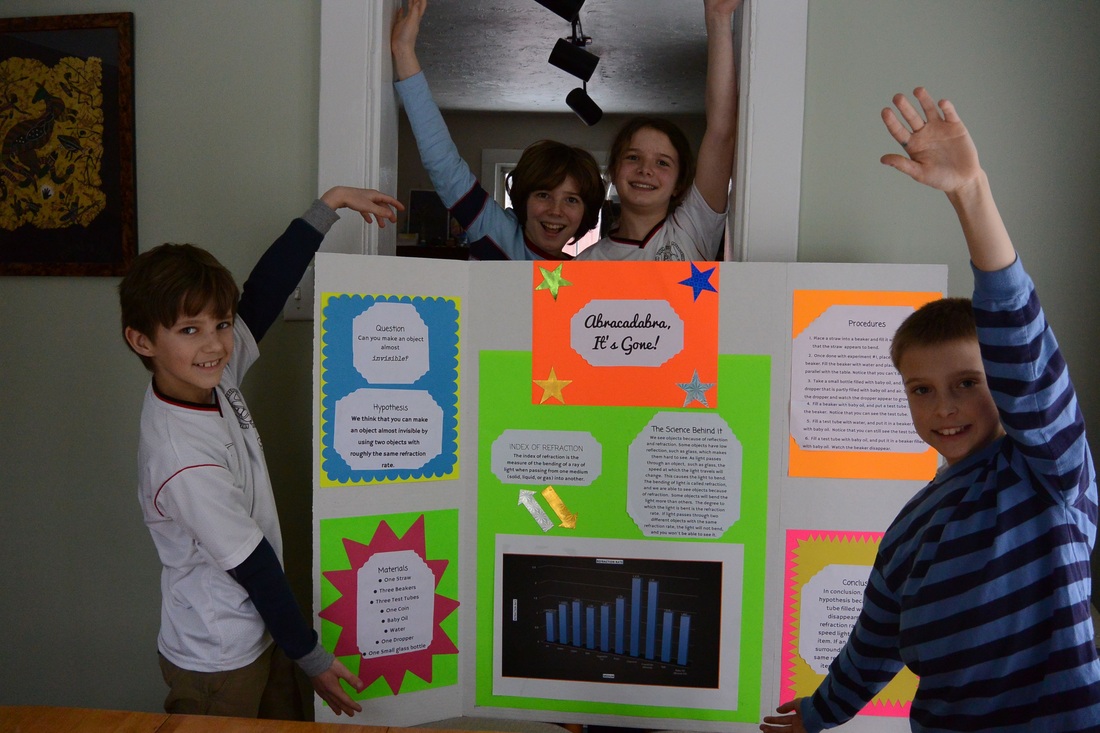
Abracadabra! It's gone!

Question: Can you make an object almost
invisible?

Hypothesis: We think that you can make an object almost invisible by using two objects with low reflection and roughly the same refraction rate.
Picture
Our Experiment

Materials: 

Picture
  • Straw
  • Three glass beakers
  • Three glass test tubes
  • Coin
  • Baby Oil
  • Water
  • Dropper
  • Small, glass bottle

Safety Procedures


Material 3:  Do not drop glass.
Material 6: Do not drink baby oil.

Procedure:


  1. Place a straw into a beaker that has been filled with water. Notice that the straw bends.
  2. Once done with experiment #1, place a coin under an empty beaker.
  3. Fill beaker with water, and place your head parallel to the table. Notice that you can't see the coin.
  4. Now, take a small bottle filled with baby oil. Insert a dropper that is partly filled with baby oil and air. Squeeze dropper and watch the dropper appear to grow longer.
  5. Next, fill a beaker with baby oil.
  6. Put an empty test tube inside of the beaker.  Notice that you can see the test tube.
  7. Fill another test tube with water and put it in the beaker filled with baby oil.  Notice that you can still see the test tube.
  8. Fill the third test tube with baby oil and put it in the beaker filled with baby oil.  Watch it disappear.


Special Needs:
Water.


Watch us in action:
<feel free to add pictures, videos, etc>

Picture
Picture

The Science behind it

     We see objects because of reflection and refraction. Some objects have low reflection, such as glass, which makes them hard to see. As light passes through an object,  like glass, the speed at which the light travels will change.  This causes the light to bend.  This is called refraction.  We are able to see objects because of refraction or bending of the light.  Some objects will bend the light more than others.  The degree to which the light is bent is the refraction rate.  If light passes through two different objects with the same refraction rate, the light will not bend, and you won't be able to see it.       

Later on you can Add Graphs with results


Conclusions
     In conclusion, we accept our hypothesis because the test tube filled with baby oil disappears due to the refraction rate, which is the speed light goes through an item. If an item and the item surrounding it have about the same refraction rate, the inner item appears INVISIBLE.

About Ray

Ray is an SIS fifth grader who likes soccer and reading. He thinks that this project is very interesting, and he wants to learn more about this phenomenon.

About Lily

Lily is also a fifth grader at SIS who also enjoys playing soccer and reading. She really likes the experiment that she and the rest of her teammates choose. 

About Colin
Colin is also in 5th grade and is in Mrs Gronert and Mrs. Pepe's class.  He enjoys reading and playing basketball.  He is very excited to demonstrate his group's chosen experiment.

About Liam
Liam is a 5th grader in Mr. Camarra's class.  He enjoys reading and likes to play soccer.  He is very excited to demonstrate this experiment.

Powered by Create your own unique website with customizable templates.