Making lava lamps
Why do the materials in a Lava Lamp react the way they do?
Even when you mix oil and water together they still separate. The oil always floats to the top because it is less dense than water. Oil and water don't mix because water molecules are more attracted to each other than to oil molecules.
Oil floats on the surface because water is heavier than oil. Water is more dense than the oil. The Alka-Seltzer tablet reacts with the water to make carbon dioxide gas. These bubbles attach themselves to the colored water and cause them to float to the surface.
Oil floats on the surface because water is heavier than oil. Water is more dense than the oil. The Alka-Seltzer tablet reacts with the water to make carbon dioxide gas. These bubbles attach themselves to the colored water and cause them to float to the surface.
Hypothesis:
The ingredients in our lava lamp (oil, water,food coloring and carbon dioxide) will react with each other to make funky balls of color that move around like a real lava lamp.
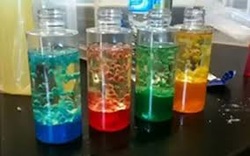
Our Experiment
Materials: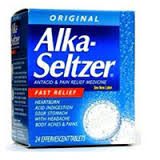
|
Safety Procedures1. Don't drink the liquid. 2. Don't eat the alka seltzer. 3. Make sure there are no holes in the bottle. |
Procedure:
.Detail steps so anyone can reproduce this at school or home
Special Needs:
1. Don't use too much oil.
2. Materials needs to be measured out exactly.
- Pour water into the plastic bottle until it is around one quarter full (you might want to use a funnel when filling the bottle so you don't spill anything).
- Pour in vegetable oil until the bottle is nearly full.
- Wait until the oil and water have separated.
- Add around a dozen drops of food coloring to the bottle (choose any color you like).
- Watch as the food coloring falls through the oil and mixes with the water.
- Cut an Alka-Seltzer tablet into smaller pieces (around 5 or 6) and drop one of them into the bottle, things should start getting a little crazy, just like a real lava lamp!
- When the bubbling stops, add another piece of Alka-Seltzer.
Special Needs:
1. Don't use too much oil.
2. Materials needs to be measured out exactly.
The Science behind it
If you've tried the oil and water experiment you'll know that the two don't mix very well. The oil and water you added to the bottle separate from each other, with oil on top because it has a lower density than water. The food coloring falls through the oil and mixes with the water at the bottom. The piece of Alka-Seltzer tablet you drop in after releases small bubbles of carbon dioxide gas that rise to the top and take some of the colored water along for the ride. The gas escapes when it reaches the top and the colored water falls back down. The reason Alka-Seltzer fizzes in such a way is because it contains citric acid and baking soda (sodium bicarbonate), the two react with water to form sodium citrate and carbon dioxide gas (those are the bubbles that carry the colored water to the top of the bottle).
Adding more Alka-Seltzer to the bottle keeps the reaction going so you can enjoy your funky lava lamp for longer. If you want to show someone later you can simply screw on a bottle cap and add more Alka-Seltzer when you need to. When you've finished all your Alka-Seltzer, you can take the experiment a step further by tightly screwing on a bottle cap and tipping the bottle back and forth, what happens then?
Adding more Alka-Seltzer to the bottle keeps the reaction going so you can enjoy your funky lava lamp for longer. If you want to show someone later you can simply screw on a bottle cap and add more Alka-Seltzer when you need to. When you've finished all your Alka-Seltzer, you can take the experiment a step further by tightly screwing on a bottle cap and tipping the bottle back and forth, what happens then?
Conclusions
After conducting our experiment we determined our hypothesis to be correct. We observed the ingredients we put in the bottle reacted as we thought they would. Because the oil and water did not mix when you turn the lava lamp upside down the food coloring moves like the funky balls of color in a real lava lamp.
About Author 1Lily is in 5th grade and is ten years old. She is in Mrs.Carvos class. In her free time Lily likes to play fetch with her dog Joey.
|
About Author 2Holly is in 5th grade and is ten years old. She is in Mrs .Carvos class. In her free time she likes to ski and swim in her pool with her sister.
|
Comments
Question: This needs to more specific: What materials react how? What is being used.
Hypothesis: What chemicals are being referred to? The reader doesn't know.
Materials:
Procedure: Look at caption below the Procedure.
Safety Procedure: Grammar and punctuation. These are sentences.
Special Needs: These are sentences and need to be punctuated properly.
Science Behind it:
Conclusion: Conclusions should be a paragraph. Was your hypothesis correct? What did you observe? What are other variables that you would like to test?
About Author: No last names. This is open to the world.
Question: This needs to more specific: What materials react how? What is being used.
Hypothesis: What chemicals are being referred to? The reader doesn't know.
Materials:
Procedure: Look at caption below the Procedure.
Safety Procedure: Grammar and punctuation. These are sentences.
Special Needs: These are sentences and need to be punctuated properly.
Science Behind it:
Conclusion: Conclusions should be a paragraph. Was your hypothesis correct? What did you observe? What are other variables that you would like to test?
About Author: No last names. This is open to the world.