A Unique Hands On Science Night
  • Home
    • Hands-On Science Night!
    • Preparing for Science Night >
      • Getting Started -1/06/12
      • Experiments Showcase - 1/13/12
      • How to Submit a Proposal - 1/20/12
      • Searching for Experiments - 1/27/12
      • Submitting Proposal - 2/6/12
      • Project Review - 2/10/12
      • Past Science Night Experiments >
        • Science Night 2014 >
          • Biology >
            • You Eat With Your Eyes First
          • Chemistry >
            • Rapid, Rainbow, Bounce
            • Homemade Hand Warmers
            • Enviro Power
            • Electric Gas
            • GLUEP
            • Blowing Up Balloons with CO2
            • Tusker Toothpaste
            • Balloon Experiments
            • Elephant Toothpaste
            • The Secret of Diapers
            • Super Absorbent Crystals
          • Physics >
            • Rainbow Milk
            • The Amazing Static Balloon
            • Bubbling Lamps of Lava
            • The Floating Egg
            • Marshmallow Cannon
            • Dry Ice Bubbles
            • Fog Tornado
            • Fun with Electromagnets
            • Poke that Polymer
            • The Square Bubble
            • Lava Lamps
            • How to Make an Egg Float
            • Super Can Crusher
            • How to Make a Homemade Lava Lamp
            • Monster Bubble
            • Levitating Orb
            • Magical Egg Bottle
            • Power of the Metal
            • Dry Ice Bubbles
            • Lava Lamps
            • The Screaming Balloon
            • Dancing Craisins
            • Colorful Densities
            • Color Separation
            • Center of Gravity
        • Science Night 2013 >
          • Biology >
            • Sensory Analysis
            • Sweet Polymers
          • Chemistry >
            • Awesome Bubbles
            • Balloon Expansion
            • Breaking Up Molecules
            • Bubble Up
            • Cabbage Chemistry
            • Color Explosion
            • Colored Bubbles
            • Fizz Inflator
            • Fool's Gold
            • Glowing Water
            • Gooey Gluey Slime
            • Holly and Jennie's Lava Lamp
            • Light Up
            • Making Bubbles
          • Earth Sciences >
            • Colorful Convection Currents
            • Ice Ice Baby
          • Physics >
            • Boo Bubbles
            • Bouncing Sounds
            • Can Crushers
            • Candle Vacuum
            • Candy Fizz
            • Colors of Light
            • Floating Paper Clip
            • Levitating Orb
            • Magical Bottle
            • Rainbow Density
            • Ready, Set, ... Throw!
            • Sink or Float?
            • Surface Tension
          • Technology >
            • Air Vortex Cannons
            • Chip Ship Challenge
            • Lemon Power
            • Wing Or No Wing?
        • Science Night 2012 >
          • Projects >
            • Chemistry >
              • Electrolyte Challenge
              • Homemade Hand Warmer
              • Elephant Toothpaste I
              • Tusker Toothpaste
              • Elephant Toothpaste III
              • Tasty Frozen Science
              • Purple Cabbage and Bases and Acids
              • Rainbow Milk
              • Pop Rocks and Soda
            • Science Night 2015 >
              • Chemistry >
                • Team 1
                • Team 3
                • Team 5
                • Team 6
                • Team 10
                • Team 11
                • Team 12
                • Team 13
                • Team 14
                • Team 19
                • Team 23
                • Team 30
                • Team 31
                • Team 32
                • Team 34
                • Team 35
                • Team 36
                • Team 37
                • Physics >
                  • Team 4
                  • Team 7
                  • Team 8
                  • Team 9
                  • Team 15
                  • Team 16
                  • Team 17
                  • Team 18
                  • Team 20
                  • Team 24
                  • Team 29
                  • Team 33
                  • Team 38
                  • Team 44
                • Team 39
                • Team 41
                • Team 42
                • Team 43
                • Team 45
                • Team 48
              • Technology >
                • Team 21
                • Team 26
                • Team 40
                • Team 47
              • Biology >
                • Team 2
                • Team 22
                • Team 28
                • Team 27
                • Team 46
            • Engineering and Technology >
              • World's Simplest Motor
              • Magnetic Levitation Train
            • Physics >
              • Water Filter
              • Stacking Liquids
              • Egg in a Bottle
            • Biology >
              • Infected!
      • A Helpful Presentation Board - 2/10/12
      • Hands-On all the way - 2/17/12
      • Practice, Practice , Practice - 3/02/12
      • More Practice 3/2/12
      • Rehearsal Afternoon - 3/15/12
    • passports
    • teaminfo
  • Run your own Science Night
  • Who are we?
  • Science Night 2016
    • Chemistry >
      • Team 2
      • Team 4
      • Team 5
      • Team 7
      • Team 13
      • Team 14
      • Team 15
      • Team 16
      • Team 18
      • Team 20
      • Team 21
      • Team 27
      • Team 28
      • Team 31
      • Team 32
      • Team 33
      • Team 34
      • Team 35
      • Team 36
      • Team 40
    • Physics >
      • Team 1
      • Team 3
      • Team 6
      • Team 9
      • Team 11
      • Team 17
      • Team 19
      • Team 22
      • Team 23
      • Team 24
      • Team 25
      • Team 26
      • Team 29
      • Team 30
      • Team 37
      • Team 38
      • Team 42
      • Team 43
      • Team 44
    • Technology >
      • Team 12
      • Team 39

FOG TORNADO


A tornado is funnel shaped column of wind that is created by...

Question: Does the size of the box effect the tornado's movement?

Hypothesis: We predict that the smaller box will have a small tornado and the big box will have a big tornado
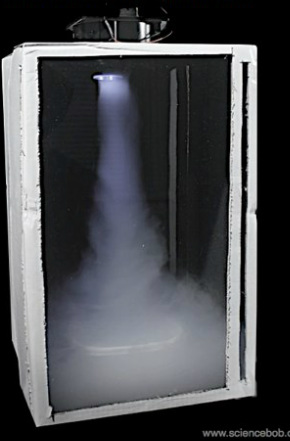
Picture
Our Experiment
Picture

Materials: 

Picture
  • black paint/spray paint
  • goggles
  • A piece of clear plastic 10 X 17 inches
  • A small 12 volt computer fan
  • A copier paper box
  • dry ice 
  • 9v battery
  • gloves
  • tongs
  • 2 small plastic bowls
  • hot water 

Safety Procedures:


 Adult supervision at home required
 Hand wear required for dry ice


The stages of a tornado:

Dust-Whirl A dust cloud forms in the whirling air at the surface.  No funnel cloud or just a small stub of a funnel cloud is visible. A vertical shaft of whirling air is present, but it is largely invisible as condensation has not yet formed clouds which make the funnel visible and insufficient dust has been picked up at the funnel's base to make anything but that portion of it nearest the ground visible. If the storm strengthens...

Organizing The winds increase. The funnel fills in.  The funnel becomes more opaque, mostly from water droplets at its top and from dust and debris at its base. Contact with the ground may be intermittent.

Mature The tornado acheives its maximum strength.  The funnel reaches its maximum width. It is nearly vertical and nearly symmetric. Contact with the ground generally persists through the mature and dissapating stages.

Dissipating or Shrinking The funnel begins to shrink in width as its damage swath also narrows. The funnel may begin to tilt. Wind velocities decrease. Damage caused by the tornado begins to decrease, but may still be severe.

Rope or Decay The tornado gradually weakens and becomes increasingly contorted until it completely dissipates. The dissipating funnel often takes on a ropelike appearance.

Procedure:

  1. Make Hypothesis
  2. Gather Materials
  3. Build Box
  4. Paint Box
  5. Place a Plastic Bowl in the Box
  6. Put the Dry Ice in the Plastic Bowl
  7. Pour Hot Water into the Plastic Bowl
  8. Turn on the 12 Volt Computer Fan
  9. Repeat Steps 3 - 7 but With a Different Size Box
  10. Record Results
  11. Conclude results

The Science behind it

The fan forces air out of the chamber, air from outside the box is forced in through the slots on the sides. The position of the slots causes the incoming air to create a VORTEX (spiral) of air as it is drawn up and out of the box. Real tornados form in a similar way using updrafts and wind-shear.

Conclusions

We reject our hypothesis because we concluded that a big box has a small tornado and the little box has a small tornado.

Meet Sam

My name is Sam Rivilis and I am 10 yrs old. I am a fun guy to be around. I am good at fishing, soccer, baseball, and skiing. I am very creative and open to many ideas.
Picture

Meet Kevin

Hello my name is Kevin Butlien and I'm 11 years old. I like to ski, play baseball and sometimes I go fishing. I am good at supporting someone's ideas and thinking of solutions to help them.  
Picture

Meet Sam and Kevin

We are great buds and barely argue. We share our ideas/ thoughts and talk about explanations to our ideas.
Powered by Create your own unique website with customizable templates.