A Unique Hands On Science Night
  • Home
    • Hands-On Science Night!
    • Preparing for Science Night >
      • Getting Started -1/06/12
      • Experiments Showcase - 1/13/12
      • How to Submit a Proposal - 1/20/12
      • Searching for Experiments - 1/27/12
      • Submitting Proposal - 2/6/12
      • Project Review - 2/10/12
      • Past Science Night Experiments >
        • Science Night 2014 >
          • Biology >
            • You Eat With Your Eyes First
          • Chemistry >
            • Rapid, Rainbow, Bounce
            • Homemade Hand Warmers
            • Enviro Power
            • Electric Gas
            • GLUEP
            • Blowing Up Balloons with CO2
            • Tusker Toothpaste
            • Balloon Experiments
            • Elephant Toothpaste
            • The Secret of Diapers
            • Super Absorbent Crystals
          • Physics >
            • Rainbow Milk
            • The Amazing Static Balloon
            • Bubbling Lamps of Lava
            • The Floating Egg
            • Marshmallow Cannon
            • Dry Ice Bubbles
            • Fog Tornado
            • Fun with Electromagnets
            • Poke that Polymer
            • The Square Bubble
            • Lava Lamps
            • How to Make an Egg Float
            • Super Can Crusher
            • How to Make a Homemade Lava Lamp
            • Monster Bubble
            • Levitating Orb
            • Magical Egg Bottle
            • Power of the Metal
            • Dry Ice Bubbles
            • Lava Lamps
            • The Screaming Balloon
            • Dancing Craisins
            • Colorful Densities
            • Color Separation
            • Center of Gravity
        • Science Night 2013 >
          • Biology >
            • Sensory Analysis
            • Sweet Polymers
          • Chemistry >
            • Awesome Bubbles
            • Balloon Expansion
            • Breaking Up Molecules
            • Bubble Up
            • Cabbage Chemistry
            • Color Explosion
            • Colored Bubbles
            • Fizz Inflator
            • Fool's Gold
            • Glowing Water
            • Gooey Gluey Slime
            • Holly and Jennie's Lava Lamp
            • Light Up
            • Making Bubbles
          • Earth Sciences >
            • Colorful Convection Currents
            • Ice Ice Baby
          • Physics >
            • Boo Bubbles
            • Bouncing Sounds
            • Can Crushers
            • Candle Vacuum
            • Candy Fizz
            • Colors of Light
            • Floating Paper Clip
            • Levitating Orb
            • Magical Bottle
            • Rainbow Density
            • Ready, Set, ... Throw!
            • Sink or Float?
            • Surface Tension
          • Technology >
            • Air Vortex Cannons
            • Chip Ship Challenge
            • Lemon Power
            • Wing Or No Wing?
        • Science Night 2012 >
          • Projects >
            • Chemistry >
              • Electrolyte Challenge
              • Homemade Hand Warmer
              • Elephant Toothpaste I
              • Tusker Toothpaste
              • Elephant Toothpaste III
              • Tasty Frozen Science
              • Purple Cabbage and Bases and Acids
              • Rainbow Milk
              • Pop Rocks and Soda
            • Science Night 2015 >
              • Chemistry >
                • Team 1
                • Team 3
                • Team 5
                • Team 6
                • Team 10
                • Team 11
                • Team 12
                • Team 13
                • Team 14
                • Team 19
                • Team 23
                • Team 30
                • Team 31
                • Team 32
                • Team 34
                • Team 35
                • Team 36
                • Team 37
                • Physics >
                  • Team 4
                  • Team 7
                  • Team 8
                  • Team 9
                  • Team 15
                  • Team 16
                  • Team 17
                  • Team 18
                  • Team 20
                  • Team 24
                  • Team 29
                  • Team 33
                  • Team 38
                  • Team 44
                • Team 39
                • Team 41
                • Team 42
                • Team 43
                • Team 45
                • Team 48
              • Technology >
                • Team 21
                • Team 26
                • Team 40
                • Team 47
              • Biology >
                • Team 2
                • Team 22
                • Team 28
                • Team 27
                • Team 46
            • Engineering and Technology >
              • World's Simplest Motor
              • Magnetic Levitation Train
            • Physics >
              • Water Filter
              • Stacking Liquids
              • Egg in a Bottle
            • Biology >
              • Infected!
      • A Helpful Presentation Board - 2/10/12
      • Hands-On all the way - 2/17/12
      • Practice, Practice , Practice - 3/02/12
      • More Practice 3/2/12
      • Rehearsal Afternoon - 3/15/12
    • passports
    • teaminfo
  • Run your own Science Night
  • Who are we?
  • Science Night 2016
    • Chemistry >
      • Team 2
      • Team 4
      • Team 5
      • Team 7
      • Team 13
      • Team 14
      • Team 15
      • Team 16
      • Team 18
      • Team 20
      • Team 21
      • Team 27
      • Team 28
      • Team 31
      • Team 32
      • Team 33
      • Team 34
      • Team 35
      • Team 36
      • Team 40
    • Physics >
      • Team 1
      • Team 3
      • Team 6
      • Team 9
      • Team 11
      • Team 17
      • Team 19
      • Team 22
      • Team 23
      • Team 24
      • Team 25
      • Team 26
      • Team 29
      • Team 30
      • Team 37
      • Team 38
      • Team 42
      • Team 43
      • Team 44
    • Technology >
      • Team 12
      • Team 39

Bubbling Lamps of Lava!!
Picture

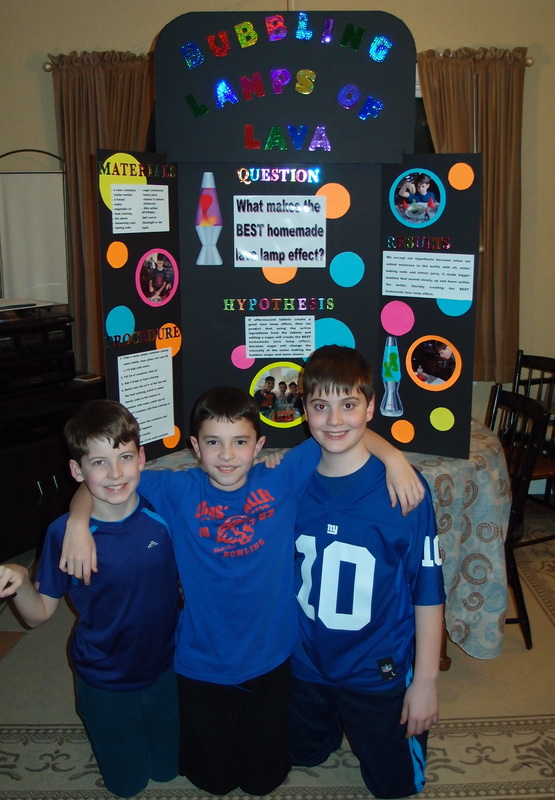
Question: What makes the BEST homemade lava lamp effect?

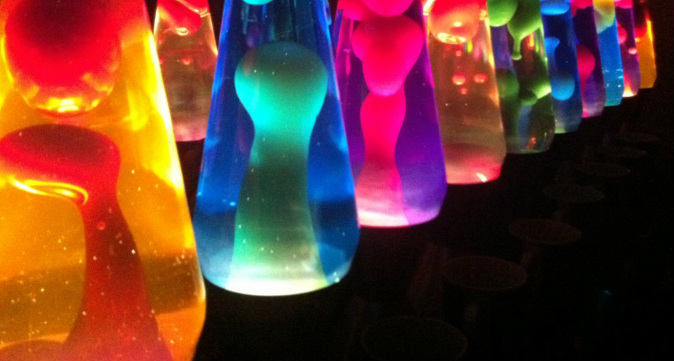
Lava lamps work by heating wax.  As the light in the bottom of the lamp warms the wax, the wax expands and its density decreases. Gravity pulls the higher density liquid down allowing the lower density, warm glob of wax to rise to the top of the lamp.  As the wax travels away from the heat source, it cools and its density increases causing it to sink.  The incandescent bulb at the bottom of the lamp heats the wax bubbles again, creating a cycle.  For our experiment, heated wax cannot be used in the time we're allowed.  So our question is: What makes the best homemade lava lamp effect?

Hypothesis:
If effervescent tablets create a good lava lamp effect, then we predict that using the active ingredients from the tablets and adding a sugar will create the BEST homemade lava lamp effect, because sugar will change the viscosity of the water making the bubbles larger and move slower.

Safety Procedures:

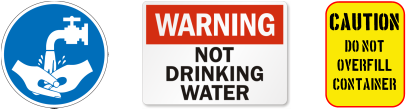
1. Wash hands.
2. Do not drink liquids.
3. Don't overfill container.
4. wait for bubbles to finish rising  before placing the cap on the bottle.
Picture

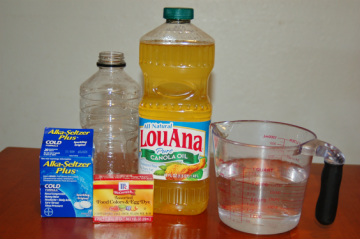
Materials: 

Picture
  • a clear container (bottle)
  • a funnel
  • water
  • vegetable oil
  • food coloring
  • tea spoon
  • measuring cups
  • baking soda
  • sugar (molasses)
  • lemon juice
  • vitamin C tablets (Airborne)
  • Alka seltzer
  • OPTIONAL: light source (flashlight or tea light)


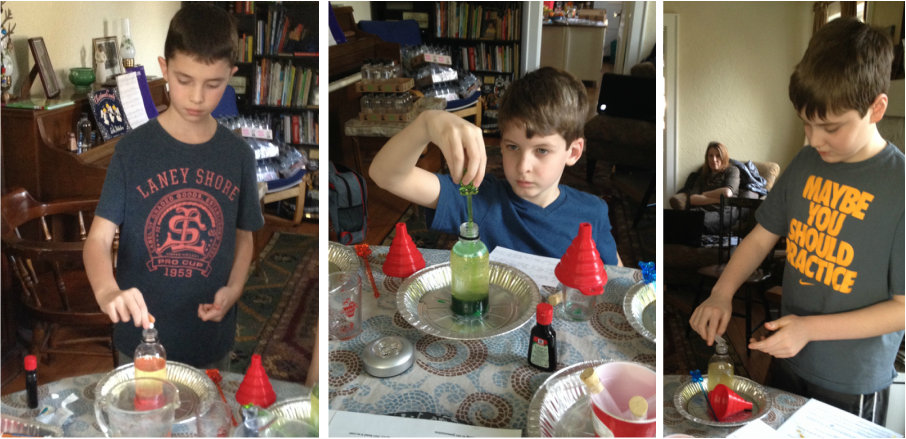
Procedure:

  1. Take a clean,empty container (empty water bottle,vase,glass,etc) and fill a 1/4 high with water.
  2. Fill 3/4 of container with vegetable oil.
  3. Add 3 drops of food coloring.
  4. Notice how the oil is at the top and the food coloring, which is water based,sinks to the bottom to combine with water.  Also the oil doesn't combine with food coloring or the water.
  5. Drop a reactant into container.  Watch what happens.
  6. Record results
  7. Repeat steps 1-6 for each reactant.

Watch us in action:

Picture
Picture

Picture
Special Needs: 
  1. An enclosed room where we can turn the lights off to make it as dark as possible.
  2. Sink with running water.

The Science Behind It:


The fluid motion that creates a lava lamp is created by the Rayleigh Taylor Instability which "is an instability of an interface between two fluids of different densities that occurs when one of the fluids is accelerated into the other".  In our experiment the acceleration is caused by the carbon dioxide bubbles and gravity.

Why does the oil sit on top of the water?
Densities: 
Density is the weight of liquids, in our case oil and water, oil and water do not mix because they have two different densities. Water is more dense, so it sinks to the bottom. The oil is less dense, so it floats to the top.
  
What keeps the oil and water from mixing?
Molecular Polarity:
Water (H2O) is what is known as a "polar" molecule. The hydrogen molecules are positively charged and the oxygen molecule is negatively charged.  Just like a opposite poles on magnets, this makes the hydrogens and the oxygen stick together AND have an overall positive charge or polarity.  This makes water a "polar" solvent. Therefore, only hydrophilic (water-loving) substances are appreciably miscible in water. Oil, on the other hand, has no polarity (neither a positive nor a negative charge). They are made of hydrocarbon chains. The elements and structure of oils are "hydrophobic" (water fearing). Since the positively charged water can't attract the oil, the two never mix.

(Immiscible fluids = fluids that can not mix together)

How can we slow down the flow of the bubbles and make the bubbles bigger?
Change the viscosity:
Viscosity is a measure of a fluid's resistance to flow. It describes the internal friction of a moving fluid. A fluid with large viscosity resists motion because its molecular makeup gives it a lot of internal friction. A fluid with low viscosity flows easily because its molecular makeup results in very little friction when it is in motion.

Adding sugar (or molasses) changes the viscosity of the water.

As an example, molasses has a slower viscosity than water. In our experiment we mix molasses with water, which will change the viscosity of the water making it slower. 


Observations:
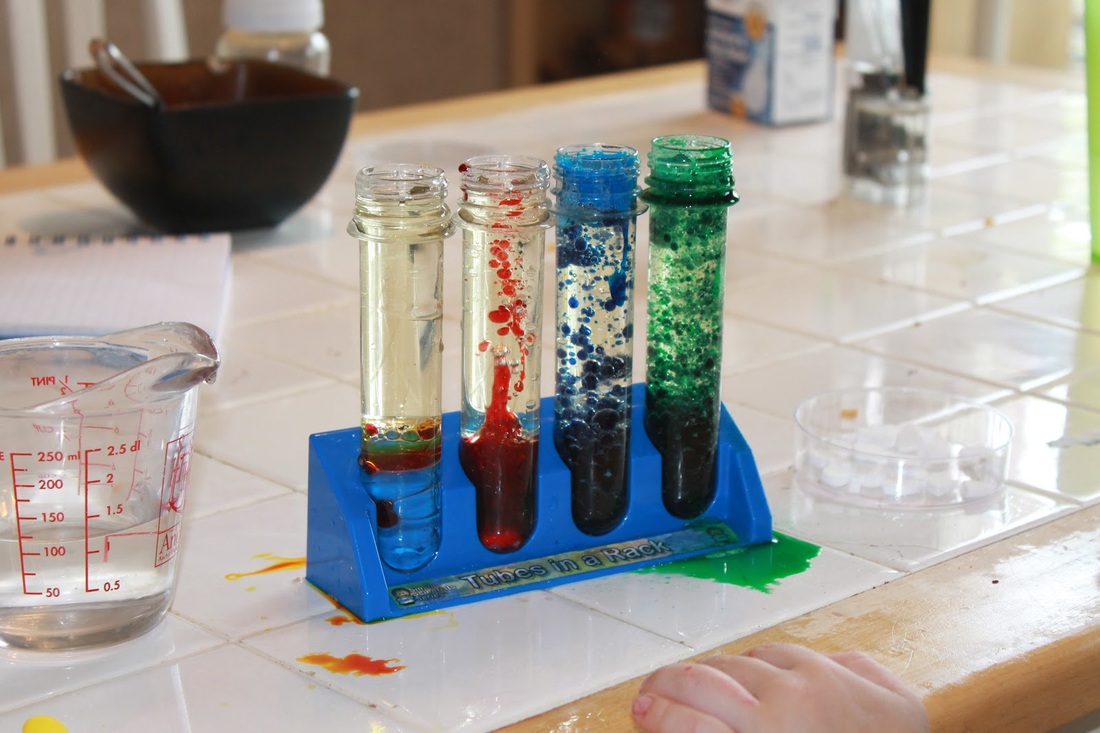
Picture
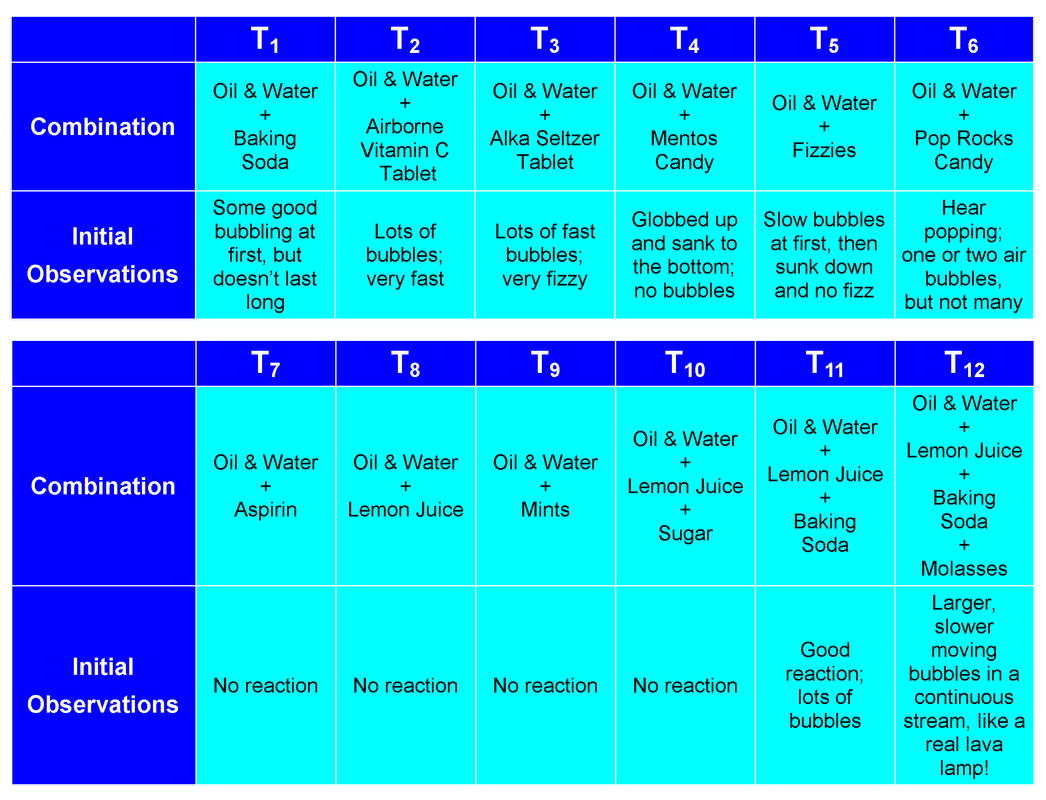
We tested several different types of "sugars" to adjust the viscosity of the water and to see which would give us the BEST homemade lava lamp effect, with large, slow moving bubbles:
  • 12 T sugar added to 100ml water - slower reaction
  • 6T sugar added to 100ml water - not much different than experiment without adding sugar
  • Stevia liquid - not much different than experiment without adding sugar
  • Honey - did not dissolve enough to change the reaction
  • Molasses - larger bubbles rose to the top and slowly descended once the CO2 was released
  • Maple Syrup - not much different than experiment without adding sugar
  • Caro Syrup - not much different than experiment without adding sugar

Conclusion:

We accept our hypothesis because when we added molasses to the bottle with oil, water, lemon juice and baking soda, it made bigger bubbles that moved slowly, up and down within the bottle, thereby creating the BEST homemade lava lamp effect.
Picture

About Anthony

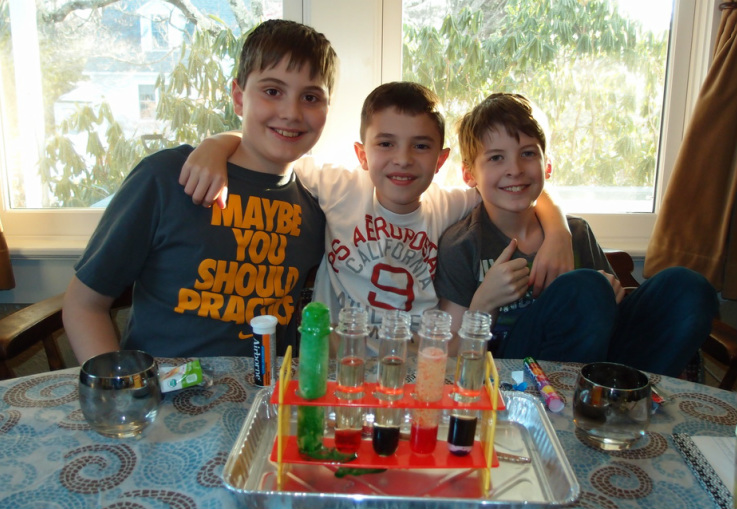
Anthony is 10 years old and in fifth grade at SIS.  His favorite things to do are playing soccer, baseball, and video games.  He also enjoys playing the trumpet.  He is an active member of Den 4, Pack 11 cub scouts. His favorite subjects in school are math and science. 

About Ryan

Ryan is a fifth grade student at Somers Intermediate School (NY) who loves sports, video games and science! When not at school, Ryan can be found on the soccer field or on the diving boards at the SUNY Purchase Aquatic Center, practicing his flips and twists.

About Tom

Tom is a 10 year old fifth grade student who loves cats and video games. His favorite subjects in school are math and language arts.  He takes piano lessons too.  His favorite sport is tennis. He hopes you have lots of fun with this project!!!
Picture
Powered by Create your own unique website with customizable templates.