Electrolyte Challenge
Problem: Can You Make a Homemade Sports Drink that is Healthier than the Drinks in the Stores?
Kids are drinking sports drinks to maintain electrolyte balance which are very unhealthy because they are full of dyes, flavorings, high fructose corn syrup, and lots of sugar! Some even have caffeine! The purpose of our experiment was to find an alternative for the bad-for-your-body sports drinks using easily obtainable ingredients that can be combined to have the same amount of, if not more, electrolytes.
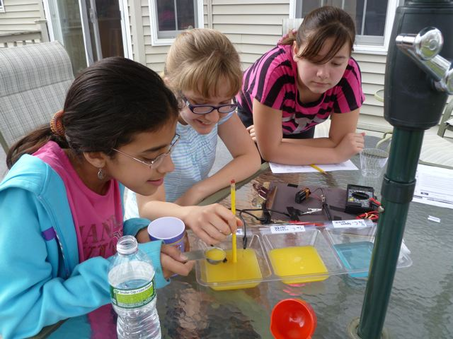
Our Experiment
Materials: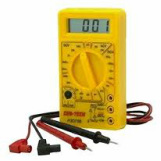
|
How Multimeters Work?
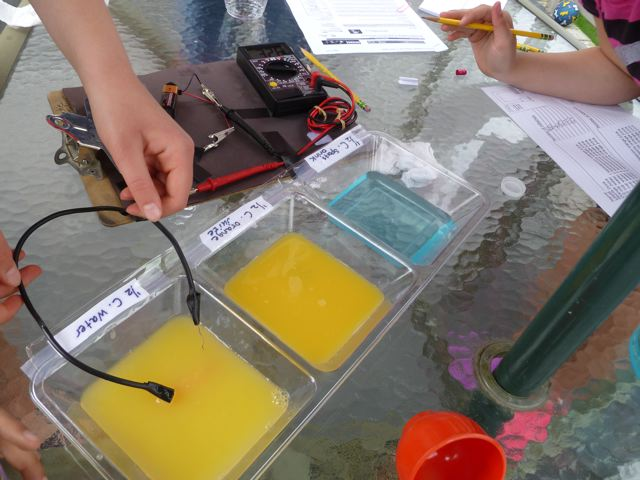
A multimeter is a multi-function electronic device that can measure voltage, resistance, and current. We are using the ammeter function in this experiment to test for current flow between two points. The two points in this case are the copper wires wrapped around the straw. The liquid flows around and next to the straw, and the ions in the liquid conduct current and complete the circuit. The current flow is recorded in units called milliamps. The number of milliamps is proportional to the number of ions in the solution. Ions are the charged particles released by the electrolytes, so the number of ions is proportional to the concentration of electrolytes.
|
Procedure:1. Pour ½ cup of sports drink into the basin labeled Sports Drink.
2.Turn multimeter on to the ammeter setting. 3. Place the straw into the Sports Drink basin. 4. Read and record the number of milliamps on to the recording sheet. 5. Rinse the straw with DH2O 6. Pour ½ cup of Orange Juice into the basin labeled Orange Juice. 7. Repeat steps 3 and 4 with the orange juice. 8. Fill up the basin labeled IKEade with ½ cup water. 9. Fill up the basin with the ½ cup of H2O, 10. Add orange juice tablespoon by tablespoon one at a time. 11. Place the straw into the IKEade basin after each tablespoon. 12. Record the number of milliamps on to the recording sheet. 13. Keep repeating steps 9, 10 and 11 until you reach the same, or above, number of milliamps as the Sports Drink. Results:
|
Watch us in action:
|
The Science Behind It:
|
We need electrolytes to ….
● carry impulses along our nerves ● help the muscles contract and relax ● keep the body from becoming too acidic or too basic ● helps regulate blood pressure ● helps regulate heartbeat What happens if you don’t get your electrolytes ??? ● dehydration ● muscle cramps ● muscle fatigue -Electrolytes separate into charged particles called ions when dissolved into water. -Positively charged electrolytes are called cations. Some examples of cations are ... ● sodium ● potassium ● magnesium ● calcium |
Electrolytes
separate into charged particles called ions when dissolved into water. Positively charged electrolytes are called cations. Some examples of cations are ... ● sodium ● potassium ● magnesium ● calcium Anions are negatively charged electrolytes. Some examples of Anions are … ● chloride ● bicarbonate |
Sweat
-Sweat is more than just water. It has a lot of electrolytes too like sodium, potassium, calcium, and magnesium. -You lose an average of 1-4 pounds of sweat per hour depending on your … ● body size ● sport ● intensity ● how well you are trained ● genes ● diet |
| Sodium | Potassium | Calcium | Magnesium | |
|---|---|---|---|---|
| Amount of loss in sweat | 800mg | 200mg | 20mg | 10mg |
| Range of number of electrolytes lost in sweat | 200-1600mg | 120-600mg | 6-40mg | 2-18mg |
As you see, sodium is the electrolyte with the most loss, and should be replenished.
What You Want to Look for in the Sports Drink You Buy...
● Good taste (if the taste is good, you will tend to drink more)
● Carbs (supplies energy for muscle contraction)
● Sodium (sodium chloride is table salt. If you notice yourself getting thirsty, that is because sodium triggers thirst. If you have a lot of sodium, you will drink more [which is good when you are exercising])
What you DO NOT want to see in the sports drinks you buy...
● caffeine (can cause anxiety and irritability)
● vitamins ( not absorbed quickly enough to be of any significance)
● herbs (like ginsing) (inadequate data available)
● carbonation (causes you to bloat)
● plastic bottles (not environmentally friendly)
The American College of Sports Medicine recommends the sports drink to have …
● 110-170 mg of sodium per 8 ounce
● 20 -50 mg of potassium per 8 ounce
● 1200-2400 mg of carbohydrates per 8 ounce
What You Want to Look for in the Sports Drink You Buy...
● Good taste (if the taste is good, you will tend to drink more)
● Carbs (supplies energy for muscle contraction)
● Sodium (sodium chloride is table salt. If you notice yourself getting thirsty, that is because sodium triggers thirst. If you have a lot of sodium, you will drink more [which is good when you are exercising])
What you DO NOT want to see in the sports drinks you buy...
● caffeine (can cause anxiety and irritability)
● vitamins ( not absorbed quickly enough to be of any significance)
● herbs (like ginsing) (inadequate data available)
● carbonation (causes you to bloat)
● plastic bottles (not environmentally friendly)
The American College of Sports Medicine recommends the sports drink to have …
● 110-170 mg of sodium per 8 ounce
● 20 -50 mg of potassium per 8 ounce
● 1200-2400 mg of carbohydrates per 8 ounce
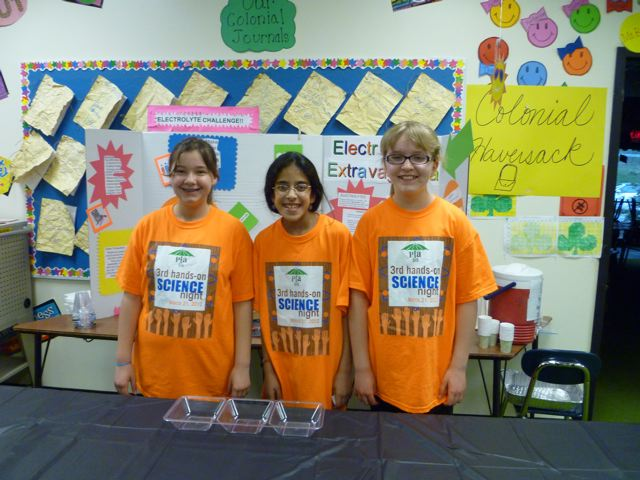
About KatieKatie is a fifth grader in Mr. Davanzo’s class. She enjoys reading, swimming, and spending time at her family’s summer house in the Adirondacks. She hopes to one day be an architect that designs more innovative buildings to help people in everyday lives. She enjoyed doing this experiment because she enjoys playing sports and wanted to find a good thing to drink during games. She also likes to make healthy snacks and IKEade is now what she drinks all the time!
|
About EmilyEmily is a fifth grader in Mr.Camarra’s class. She enjoys acting, softball and going her family’s house in Cape May during the summer. She would like to become a professional actress when she grows up. She enjoyed this experiment because she liked mixing all the ingredients together. When she is playing sports and needs a refreshing beverage after each game. She’ll usually go for a sports drink, but is that really the right choice?
|
About Isha
Isha is in Mr. Benedetto’s 5th grade class. She likes to read, write, and go on exciting trips with her family. She wants to be a astrophysicist or an engineer when she grows up. She loved this experiment because it is trying to prove something that effects a lot of people.
|