A Unique Hands On Science Night
  • Home
    • Hands-On Science Night!
    • Preparing for Science Night >
      • Getting Started -1/06/12
      • Experiments Showcase - 1/13/12
      • How to Submit a Proposal - 1/20/12
      • Searching for Experiments - 1/27/12
      • Submitting Proposal - 2/6/12
      • Project Review - 2/10/12
      • Past Science Night Experiments >
        • Science Night 2014 >
          • Biology >
            • You Eat With Your Eyes First
          • Chemistry >
            • Rapid, Rainbow, Bounce
            • Homemade Hand Warmers
            • Enviro Power
            • Electric Gas
            • GLUEP
            • Blowing Up Balloons with CO2
            • Tusker Toothpaste
            • Balloon Experiments
            • Elephant Toothpaste
            • The Secret of Diapers
            • Super Absorbent Crystals
          • Physics >
            • Rainbow Milk
            • The Amazing Static Balloon
            • Bubbling Lamps of Lava
            • The Floating Egg
            • Marshmallow Cannon
            • Dry Ice Bubbles
            • Fog Tornado
            • Fun with Electromagnets
            • Poke that Polymer
            • The Square Bubble
            • Lava Lamps
            • How to Make an Egg Float
            • Super Can Crusher
            • How to Make a Homemade Lava Lamp
            • Monster Bubble
            • Levitating Orb
            • Magical Egg Bottle
            • Power of the Metal
            • Dry Ice Bubbles
            • Lava Lamps
            • The Screaming Balloon
            • Dancing Craisins
            • Colorful Densities
            • Color Separation
            • Center of Gravity
        • Science Night 2013 >
          • Biology >
            • Sensory Analysis
            • Sweet Polymers
          • Chemistry >
            • Awesome Bubbles
            • Balloon Expansion
            • Breaking Up Molecules
            • Bubble Up
            • Cabbage Chemistry
            • Color Explosion
            • Colored Bubbles
            • Fizz Inflator
            • Fool's Gold
            • Glowing Water
            • Gooey Gluey Slime
            • Holly and Jennie's Lava Lamp
            • Light Up
            • Making Bubbles
          • Earth Sciences >
            • Colorful Convection Currents
            • Ice Ice Baby
          • Physics >
            • Boo Bubbles
            • Bouncing Sounds
            • Can Crushers
            • Candle Vacuum
            • Candy Fizz
            • Colors of Light
            • Floating Paper Clip
            • Levitating Orb
            • Magical Bottle
            • Rainbow Density
            • Ready, Set, ... Throw!
            • Sink or Float?
            • Surface Tension
          • Technology >
            • Air Vortex Cannons
            • Chip Ship Challenge
            • Lemon Power
            • Wing Or No Wing?
        • Science Night 2012 >
          • Projects >
            • Chemistry >
              • Electrolyte Challenge
              • Homemade Hand Warmer
              • Elephant Toothpaste I
              • Tusker Toothpaste
              • Elephant Toothpaste III
              • Tasty Frozen Science
              • Purple Cabbage and Bases and Acids
              • Rainbow Milk
              • Pop Rocks and Soda
            • Science Night 2015 >
              • Chemistry >
                • Team 1
                • Team 3
                • Team 5
                • Team 6
                • Team 10
                • Team 11
                • Team 12
                • Team 13
                • Team 14
                • Team 19
                • Team 23
                • Team 30
                • Team 31
                • Team 32
                • Team 34
                • Team 35
                • Team 36
                • Team 37
                • Physics >
                  • Team 4
                  • Team 7
                  • Team 8
                  • Team 9
                  • Team 15
                  • Team 16
                  • Team 17
                  • Team 18
                  • Team 20
                  • Team 24
                  • Team 29
                  • Team 33
                  • Team 38
                  • Team 44
                • Team 39
                • Team 41
                • Team 42
                • Team 43
                • Team 45
                • Team 48
              • Technology >
                • Team 21
                • Team 26
                • Team 40
                • Team 47
              • Biology >
                • Team 2
                • Team 22
                • Team 28
                • Team 27
                • Team 46
            • Engineering and Technology >
              • World's Simplest Motor
              • Magnetic Levitation Train
            • Physics >
              • Water Filter
              • Stacking Liquids
              • Egg in a Bottle
            • Biology >
              • Infected!
      • A Helpful Presentation Board - 2/10/12
      • Hands-On all the way - 2/17/12
      • Practice, Practice , Practice - 3/02/12
      • More Practice 3/2/12
      • Rehearsal Afternoon - 3/15/12
    • passports
    • teaminfo
  • Run your own Science Night
  • Who are we?
  • Science Night 2016
    • Chemistry >
      • Team 2
      • Team 4
      • Team 5
      • Team 7
      • Team 13
      • Team 14
      • Team 15
      • Team 16
      • Team 18
      • Team 20
      • Team 21
      • Team 27
      • Team 28
      • Team 31
      • Team 32
      • Team 33
      • Team 34
      • Team 35
      • Team 36
      • Team 40
    • Physics >
      • Team 1
      • Team 3
      • Team 6
      • Team 9
      • Team 11
      • Team 17
      • Team 19
      • Team 22
      • Team 23
      • Team 24
      • Team 25
      • Team 26
      • Team 29
      • Team 30
      • Team 37
      • Team 38
      • Team 42
      • Team 43
      • Team 44
    • Technology >
      • Team 12
      • Team 39

Egg in a Bottle

Question: How can we get a boiled egg in and out of a bottle without breaking the egg?
Picture

Materials: 

Picture
You will need:
  • A Large Hard boiled egg
  • A glass flask with a mouth smaller than the diameter of the egg 
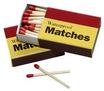
  • Matches
  • Dry ice
  • Baking Soda
  • Vinegar
  • Large plastic bin

Safety Procedures

Before we begin, know the following:
To strike a match: get a match and close the match box
Scratch  with a motion away from your body the red head against the sand paper on the side of the box
If it starts to get hot put off the flame or drop it in the large bin.
Handling Dry Ice: Dry ice is carbon dioxide in solid form and stays in the form at -110 degrees Fahrenheit. Although you can hold it in your hands for a few instants it will burn your skin, it will be best to use some insulated gloves to handle it 

Procedure:

Getting the Egg In
  1. Strike a Match and drop it in the bottle
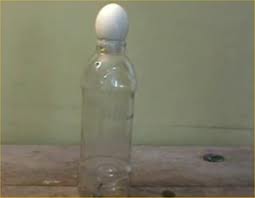
  2. Quickly place the egg on top of the bottle, pointy part of the egg inside the bottle
  3. Observe what happens - 
  4. By no means push the egg in the bottle - we don't want egg salad nor want to clean the bottle
 Getting the Egg Out
  1. Add a piece of  dry ice to the bottle 
  2. Move the bottle carefully to guide the point part of the egg to the mouth of the bottle
  3. Hold the bottle upside down 
  4. Observe what happens
or...
  1. Add 1 table spoon of Baking Soda in the bottle
  2. Add 3 table spoons of vinegar in the bottle
  3. Quickly turn the bottle over the bin and try to get the egg to cover the mouth of the bottle
  4. Hold the bottle upside down 
  5. Observe what happens
If the egg gets stuck going in or coming out
  1. Put the bottle on top of the dry ice to cool down the bottle
  2. Observer what happens

Watch us in action:

Picture
Picture

What Happened?  the science behind it

Air pressure is playing games in this experiment.
Going In:
       The match inside the bottle warmed up the air inside and increase the pressure of the air. If you look closely you will see the egg bounce a little that is the air under high pressure trying to escape. But as soon as the match goes off and the bottle starts to cool down the pressure inside the bottle starts to drop, pressure and temperature go together. The egg on top closes the system and as the pressure continues to drop a vacuum is created and an imbalance of pressure occurs between the inside and outside of the bottle. The pressure outside is higher and given that there is a vacuum inside it is easy for the pressure outside to push the egg in.
Going Out:
      Basically we do the reverse, we increase the pressure inside the bottle, and the higher pressure again pushes the egg in the other direction. In the case of the dry ice, it sublimates, phase change from Solid to Gas, the gas fills the container and increases the pressure and pushes the egg. In the case of the baking soda and vinegar, it creates a chemical reaction that also generates a gas, the same gas of the dry ice : carbon dioxide, and the added gas does the same as before - this way is just more messier :-) There are other ways to get the egg out can you think of them?
If it gets stuck:
     Basically by cooling the bottle we try to drop the temperature inside the bottle and therefore drop the pressure inside to have the air pressure in the outside push the egg in.

If it doesn't work - usually is because the egg has a crack, or it has dimples that don't fully seal the mouth of the bottle - try with another egg. Older eggs seem to work better .... and smell a little funnier

Did you like our experiment?

I am  Joe

I am at  SIS in Somers - Love Science and Soccer
Teaching 3rd and 4th graders at Science Night - was quite an experience. I liked the kid that before we gave him the instructions he ate the egg - he hadn't had any dinner... poor thing. Luckily we had a few extras

I am Lucy

I am in 5ht grade with Joe in Mr B's class, prefer Lacrosse and love science and writing.
What Joe is not telling is that he finished 3 eggs at the end of Science Night - he also was hungry - We loved science night!
Powered by Create your own unique website with customizable templates.